


Organizing Ideas
Home organization 101: Pretty organized

Home organization 101: Pretty organized
Organizing Ideas
Home organization 101: Pretty organized
When people find out I write this column, talk inevitably turns to their homes (and mine!). Not surprisingly, I've found that many of us share common misconceptions and insecurities about the whole notion of organizing.
Myth 1: People think their homes have to be perfect.
Myth 2: Organizing and beautifying are separate stages in creating a home.
Myth 3: Uncluttered means empty and sterile. This month's column is devoted to busting those myths.
I spoke with Judith Wilson, an interiors and storage expert, writer and stylist in London, about how to create storage that works and looks great. In her book The Well-Organized Home: Hard-Working Solutions For Every Room in the House (Ryland Peters & Small, 2005), Judith shows readers how to marry function and beauty (the key is to "style" items -- a useful term from the magazine industry) in organizing and storage systems. The featured rooms, some of which are shown here, are proof that an organized home is a wonderful thing. Judith says that with planning, a bit of work and some stylist's tricks, you can easily be your own home storage expert.
Storage solutions
See the big picture. Be clear about what goes where and in what type of storage. List the rooms in your home and who primarily uses each, then make a fairly complete list of what's stored in them. Or sketch a floor plan and draw arrows to the side margin, where you can list what will go where.
Know your organizing style. Are you tidy or more comfortable in organized chaos? "If you're naturally messy and you design a storage system where everything is behind closed doors, you're setting yourself up for failure," says Judith. You'll probably avoid tidying, and when you do, you might feel ill at ease in such a strictly ordered environment.
Be specific. Do an inventory of whatever you're creating a storage solution for. Count your CDs, for instance, and calculate how much room you need to store them. Then buy the proper piece of furniture or order a built-in. With clothes, count and measure the width you need for hanging them. Allow extra space for new purchases, and ensure the depth of the unit is sufficient. Plan on enough large deep shelves for sweaters and jeans.
A stylish strategy
Choose furniture with storage, including sideboards, armoires and tables with drawers or cabinets, and use the surfaces for display. "If everything is behind closed doors, a room can look cold," says Judith.
Create a cohesive look throughout your home. From room to room, repeat a style of shelving, pick up on a common architectural detail or choose similar styles of furniture
to create a calming, uncluttered look.
Look at your house with a stylist's eye. Take a picture and you'll quickly see two things: (1) where clutter builds up, in which case you can address the problem by putting an organizing system in place; and (2) whether things on open shelves are unsightly. "Randomly filled open shelves can be messy," says Judith. "Find a basket you like, be it seagrass or leather, and invest in 20 or 30." They'll tidy up the shelves and create impact. Consider buying extras, as you might not find the same containers later. Continue taking pictures to assess your arrangement. Beautiful built-ins
Let the architectural detailing of the house, like fretwork or panelling, influence the style of built-in storage you choose.
Consider devoting a wall to floor-to-ceiling built-in cabinets with flush doors and touch catches. When painted in the same colour as the walls, cabinets practically disappear.
If you plan on building a custom storage unit or niche for your TV, talk to your builder and electrician about the dimensions (you must allow enough room for air flow, so the unit doesn't get too hot).
Be your own expert. You don't necessarily need a pro to design your built-ins or solve your storage woes. Look through design books and magazines for an inspiring picture -- maybe it's shelves built around a door. A good craftsman or cabinetmaker can work from that, and even improve the design to suit your needs and your space.
 Photography by Polly Wreford, from
The Well-Organized Home: Hard-Working Solutions for Every Room in the House
(Ryland Peters & Small, 2005). Image used with permission from Ryland Peters & Small.
Photography by Polly Wreford, from
The Well-Organized Home: Hard-Working Solutions for Every Room in the House
(Ryland Peters & Small, 2005). Image used with permission from Ryland Peters & Small.

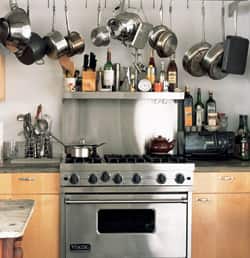 1 "If you've chosen a method of storage that's open and on view, you have to be fussy about things like how the bowls and plates look stacked," says Judith. In this cook's kitchen, equipment, serving pieces and ingredients are on display, but the kitchen doesn't look cluttered or overly industrial. "It sounds precious, but look at the colour and illustrations on labels when you're buying vinegars and oils, and see if they're attractive. Then spend a few hours setting up things so that it works and looks good."
LESSON Don't commit to closed storage just because you're afraid of clutter; instead, spend time styling what you've organized, moving things around till they look good. 2 "Organizing doesn't mean sterile," says Judith. "You do want to leave out beautiful objects that you enjoy looking at." When you plan for storage, Judith suggests including display space for candles, a few books, rotating stacks of CDs beside the stereo, magazines and the like. Also, don't go overboard with built-ins; choose freestanding furniture with storage, style and personality to supplement your built-in storage.
LESSONS Mix open and closed storage, and give thought to what objects are on display.
 3 "This is a particularly sophisticated TV cabinet," says Judith. "The beautiful walnut doors slide open and closed and match the cabinet below." However, she notes the trend today is to put plasma and flatscreen TVs on display. "Because they're so good-looking, we don't have to hide them."
LESSON Whether you like your technology on view or behind closed doors is a matter of personal preference. Whatever option you choose, make sure cords (until we have a completely wireless universe!) are well hidden. 4 "If you can create an efficient, hardworking space that actually looks good, you can turn a task like laundry, which most people don't enjoy, into something much more pleasurable," says Judith. Everything in a good laundry centre is within arm's reach -- drying racks, products, a pullout ironing board, even a tabletop for folding -- and it all closes away behind cupboard doors. When planning such a centre, imagine doing the tasks, noting everything you'll need as you go through each action from start to finish, and plan the space accordingly.
LESSON Don't avoid organizing utility areas. They're the backbone of the house; highly functional laundry and storage rooms will keep your house working like a well-oiled machine.
 Photography by Jan Baldwin (kitchen and TV storage), from
The Well-Organized Home: Hard-Working Solutions for Every Room in the House
(Ryland Peters & Small, 2005). Images used with permission from Ryland Peters & Small.
Photography by Jan Baldwin (kitchen and TV storage), from
The Well-Organized Home: Hard-Working Solutions for Every Room in the House
(Ryland Peters & Small, 2005). Images used with permission from Ryland Peters & Small.
 5 Don't overlook the value of a chest of drawers in the pursuit of built-in clothes storage, says Judith. "It not only provides much-needed storage for small items like socks and underwear, for which narrow drawers are especially good, but also offers a tabletop surface that's essential for things like a radio, clock and jewelry."
LESSON Sometimes what worked centuries ago still does the job perfectly well today. 6 "For the first time, I've organized my clothes closet by colour, and it works," says Judith. "You can see at a glance what goes with what." In an ideal dressing room, floor-to-ceiling cabinets provide hanging and shelf space for clothes. Take tips from merchandising displays and storage for a look that's visually pleasing and organized. Include hooks for robes, and tomorrow's wardrobe, which can be pulled out the night before.
LESSON Provide enough space for clothing and systems, including shelves, rods, hooks and hampers.
 7 "In the bathroom, a niche is a useful place for storage that looks finished and professional -- so much better than a shelf stuck on a wall," says Judith. If you're redoing the bath, think about where a niche might make the room more functional, such as in the shower or bath area for shampoo, or by the sink for towels, toiletries and display.
LESSON At the reno stage, imagine how you'll use the bathroom, down to the smallest details (like where you want to put your shampoo bottle when showering). Now's the time to invest in storage.
Photography by Debi Treloar (bathroom), from
The Well-Organized Home: Hard-Working Solutions for Every Room in the House
(Ryland Peters & Small, 2005). Images used with permission from Ryland Peters & Small.





Comments